A = W / V
1000 W at 12 V is about 83 A; the same 1000 W at 230 V is just over 4 A.
Calculator
Pick your voltage and enter watts or amps. The result is the current you use for the rest of your wire size and fuse calculations.
The result is guidance based on your input. Manufacturer instructions and local regulations always take precedence; you remain responsible for the installation.
Cables and fuses are chosen on amps, not watts. The same power draws four times the current at 12 V as it does at 48 V, and therefore a far thicker cable. That makes this conversion almost always the first step.
1000 W at 12 V is about 83 A; the same 1000 W at 230 V is just over 4 A.
If the label only lists a current, this gives you the power.
A 230V load behind an inverter draws more on the battery side than this conversion suggests: include the inverter efficiency.
Designing a complete electrical system? In WireElectric you do not convert per load: the app knows the power of each component and works out the current per connection itself.
You can start drawing without an account.
Open WireElectric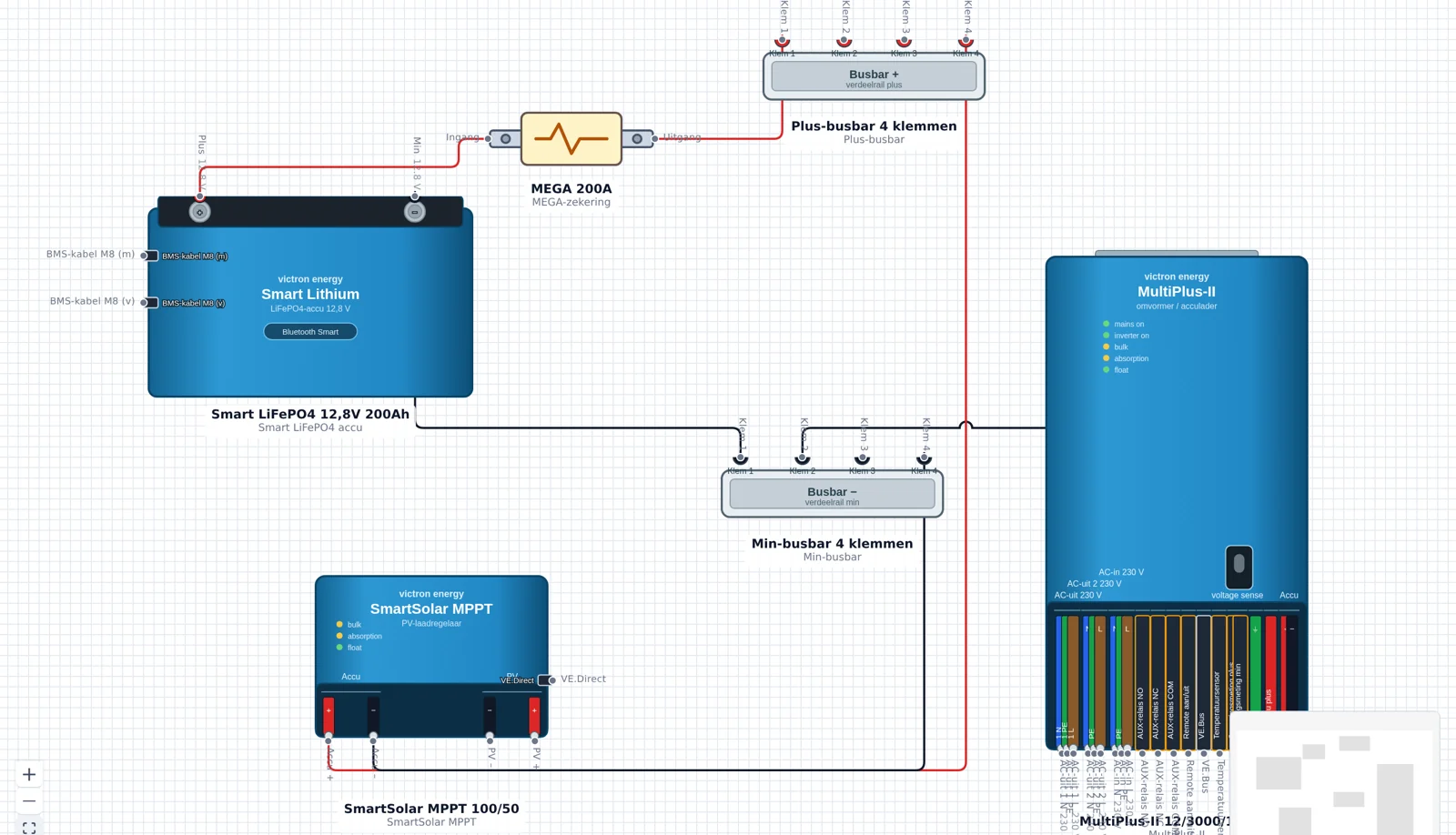
Every calculator answers one question about your installation. WireElectric then runs the same calculations for every connection in your complete diagram.
Find the cross-section that suits your 12V or 24V system, based on current, length and voltage drop.
View →Find a suitable fuse for your circuit, including a check on whether the cable can carry it.
View →Check how much voltage you lose over a cable and what reaches your load.
View →Work out how much battery capacity in Ah you need for your daily use and autonomy.
View →Calculate how long a battery can power a load, including the usable share and inverter losses.
View →Work out indicatively how many Wp of solar panels your daily consumption needs.
View →